
How to blend wellbeing into leadership?
Updated: Sep 10
The confidence to say "I'm not okay" - and why it might be the bravest thing you do
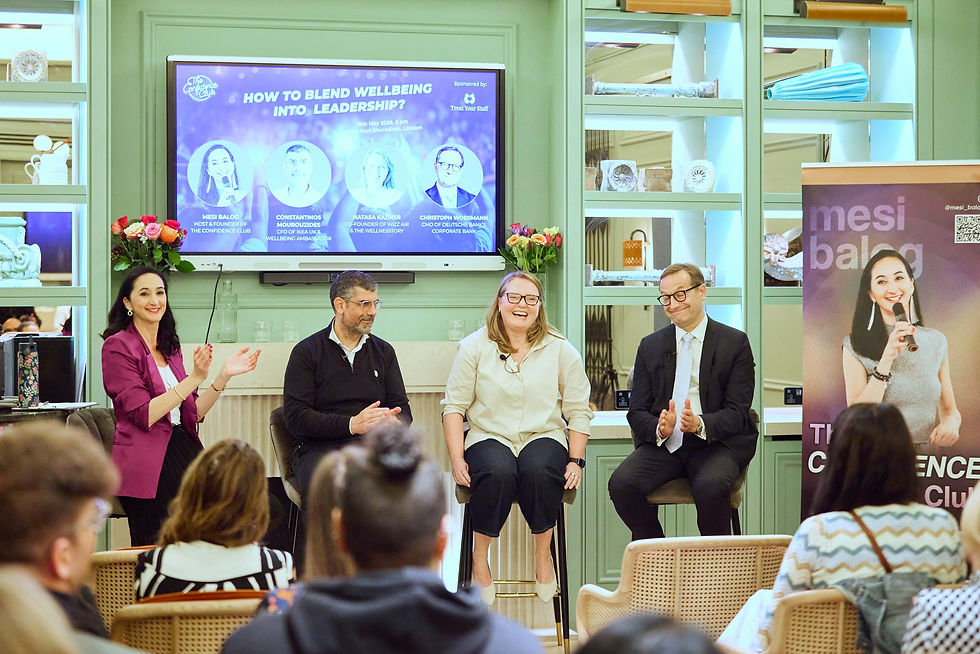
I'll be honest with you. When I sat down to plan this event, I thought I was going to get a conversation about leadership. About big careers, impressive titles, lessons from the top. And yes, all of that was there. But what I actually got was something much more interesting.
I got three people — a CFO, an airline co-founder, and a banker — who were willing to talk openly about the moments they fell apart. About the years they spent running on empty without realising it. About the gap between how they looked from the outside and how they actually felt on the inside.
And if you ask me, that's the real confidence conversation. Not the highlight reel. The honest version.
Running on adrenaline isn't the same as being well
Natasha co-founded Wizz Air. Six people, no aircraft, three months to launch a functioning airline. She was in her element — successful, driven, unstoppable. And she felt absolutely fine.
Until she didn't.
Years later, during her IVF journey, her doctor asked how she'd managed stress throughout her corporate career. She told him she hadn't really felt stressed. And he said something I think a lot of us need to hear:
"Your body doesn't care what you felt. Stress is stored on a cellular level."
She had never stopped to recover. Not properly. Not once in nearly a decade. She thought feeling fine meant she was fine. Her body knew different.
I think so many of us are living in that gap right now. We tell ourselves we're managing, we're strong, we can handle it, and maybe on the surface we can but underneath, our nervous system is quietly keeping score.
The confidence to actually pause — to say "I need to recover, I need to rest, I need to stop" — that's not weakness. That's one of the hardest things to do when everything around you is telling you to push through.
What a CFO sharing his divorce taught me about real confidence
Constantinos is the CFO of IKEA UK and Ireland. Senior as it gets. And at one of the hardest points in his personal life — going through a divorce — his coach challenged him to tell his team what was going on.
He did it. He walked into a meeting and said: I'm not in a great place right now. Here's why. I need your support.
His team rallied around him immediately. But what struck me most wasn't that — it was what he said about the aftermath. By going first, by showing that it was okay to not be okay, he made it safe for everyone else to do the same.
We talk about confidence like it means having everything together. Knowing all the answers. Never wobbling. But real confidence? It's the courage to be honest. With your team, with the people around you — and maybe most importantly, with yourself.
The mask we put on every day costs us more than we think. Constantinos had 21 years at IKEA and a CFO title, and he still found it hard to say "I'm struggling." So if you're finding it hard too, you're in very good company.
Stepping out of your comfort zone — for two minutes, in cold water
Kristoff has been at Deutsche Bank for 34 years. He's seen everything. And his wellbeing non-negotiable? Cold showers. Two minutes, every morning, 21 days in a row — no breaks, no skipping.
The reason isn't just physical. It's about training your brain. When you do something consistently for 21 consecutive days, you build a neuropathway. Your brain wires itself around that new behaviour. After a while, you don't have to force yourself anymore — it just becomes part of who you are.
He said something I wrote down immediately:
"Learning really starts when it hurts. Not when you say 'oh, it's cool, I can do it.'"
The things that have made me grow — the events I was terrified to run, the conversations I didn't want to have, the version of myself I had to push through fear to become — none of those felt comfortable. Comfort doesn't build you. The slightly-too-cold, slightly-too-hard thing does.
What's your cold shower? What's the small, uncomfortable thing you could commit to for 21 days that would change how you feel about yourself?
For the women reading this — this part is for you
At one point in our conversation, Natasha asked a question that changed the energy in the room. She asked whether showing vulnerability — like Constantinos had done with his team — would be equally acceptable for a woman in the same position.
And the honest answer is: not always. Not everywhere. Not yet.
Natasha spent years being the unofficial "fire extinguisher" at Wizz Air — sent in after aggressive leadership had damaged people, to pick up the emotional pieces. She was good at it. But it was never named as leadership. It was just expected.
Women who make it to senior levels often get there by outperforming the toughest version of the standards set around them. And by the time they've got 15 or 20 years of hard-won experience, their bodies are exhausted. Hormones are shifting. Energy is different. And still, somehow, we're expected to just keep going.
The confidence to say "I am not a machine" — to honour the way your body works rather than fight against it — that's a conversation we need to be having a lot more.
It always comes back to us
The thread that ran through the whole evening — the thing all three guests kept circling back to — was this: at the end of the day, it comes down to us.
Not the company. Not the manager. Not the economy or the workload or the impossible schedule — even when all those things are real and hard. What we can control is our response. Our small daily actions. The 1% we choose to do differently every single day.
Natasha recovered. She has a nine-year-old son, a business she loves, and a life that's genuinely hers. Constantinos is leading one of the most people-first organisations I've ever encountered. Kristoff has built a team where most people have stayed for 18-plus years — because he earned their respect, not just their compliance.
None of it happened because circumstances became easy. It happened because they each, in their own way, decided to take the wheel.
That's the work. And honestly? That's what The Confidence Club is all about.
Want to be part of the next conversation?
The Confidence Club is a growing community for people who want to show up differently — in their careers, their relationships, and their lives. Whether you're at the top of your game or quietly rebuilding, there's a seat for you here.


Comments